
Does homeowners insurance cover mold? The short answer: homeowners insurance covers mold only when it grew because of a problem the policy already covers, such as a burst pipe or water from putting out a fire. Even then, most policies limit what they will pay for mold to a separate, much smaller amount. Mold that came from humidity, condensation, a leaky window that was never fixed, or a flood is almost always excluded. Here is how that plays out for homes in Georgia’s humid climate, and how to give a legitimate mold claim its best chance.
This is general information, not insurance or legal advice. Policies differ, so check your own wording and ask your agent.

Why does homeowners insurance cover mold differently from other damage?
Mold is not a cause of loss. It is a consequence. Insurers write policies around causes, and they ask one question when mold shows up: what made the material wet in the first place?
- If the answer is a covered cause, such as a supply line that burst last week, the resulting mold is part of that claim, subject to the policy’s mold limit.
- If the answer is an excluded cause, such as groundwater, a flood, or a leak that dripped for a year, the mold is excluded along with the water damage.
- If the answer is no event at all, just a damp crawl space or a bathroom without a fan, the mold is considered a maintenance issue and is not covered.
Georgia’s long, humid summers make the third category common. A home in Peachtree Corners or Lawrenceville with a crawl space that reads 75 percent humidity all July will grow mold on floor joists without any pipe failing. That is a building problem, not an insurance event.
The mold sub-limit, and why it matters
After the national rise in mold claims in the early 2000s, carriers began adding a sub-limit for “fungi, wet or dry rot, and bacteria.” The sub-limit is usually a fixed dollar amount that is a small fraction of the dwelling coverage, and it typically has to stretch across:
- Testing and assessment
- Removal of mold and of the materials it is on
- Tear-out needed to reach hidden mold
- Repairs to put those areas back
- Sometimes additional living expenses while the work is done
The practical effect is that a covered claim can still leave you paying out of pocket if the mold spread far before anyone found it. Some insurers sell a higher mold limit as an endorsement. If you own an older home, a finished basement or a crawl space, it is worth asking what it costs.
Does homeowners insurance cover mold in these situations?
| Situation | Usual outcome |
|---|---|
| Washing machine hose bursts while you are at work; mold found on the drywall a week later | Covered, including mold, up to the mold sub-limit |
| Shower pan has leaked into the subfloor for two years | Usually excluded as a long-term leak |
| Creek floods the basement, mold follows | Excluded; a flood policy may cover cleanup but typically not mold that developed after the water receded |
| Roof damaged in a storm, rain soaks the attic, mold on the sheathing | Usually covered as part of the storm claim |
| Mold around bathroom window from steam and no exhaust fan | Excluded as condensation and maintenance |
| Mold inside HVAC ducts | Depends entirely on the cause; a covered water event may bring duct cleaning into the claim, condensation alone will not |
How to file a mold claim that holds up
- Find and stop the water source first. Insurers expect you to prevent further damage. Shutting the valve or tarping the roof is step one.
- Document the event, not just the mold. Photos of the burst fitting, the storm damage or the overflowing appliance connect the mold to a covered cause. Mold photos alone invite the “gradual” argument.
- Report quickly. A mold claim reported weeks after the water event raises the question of whether the delay let the mold spread.
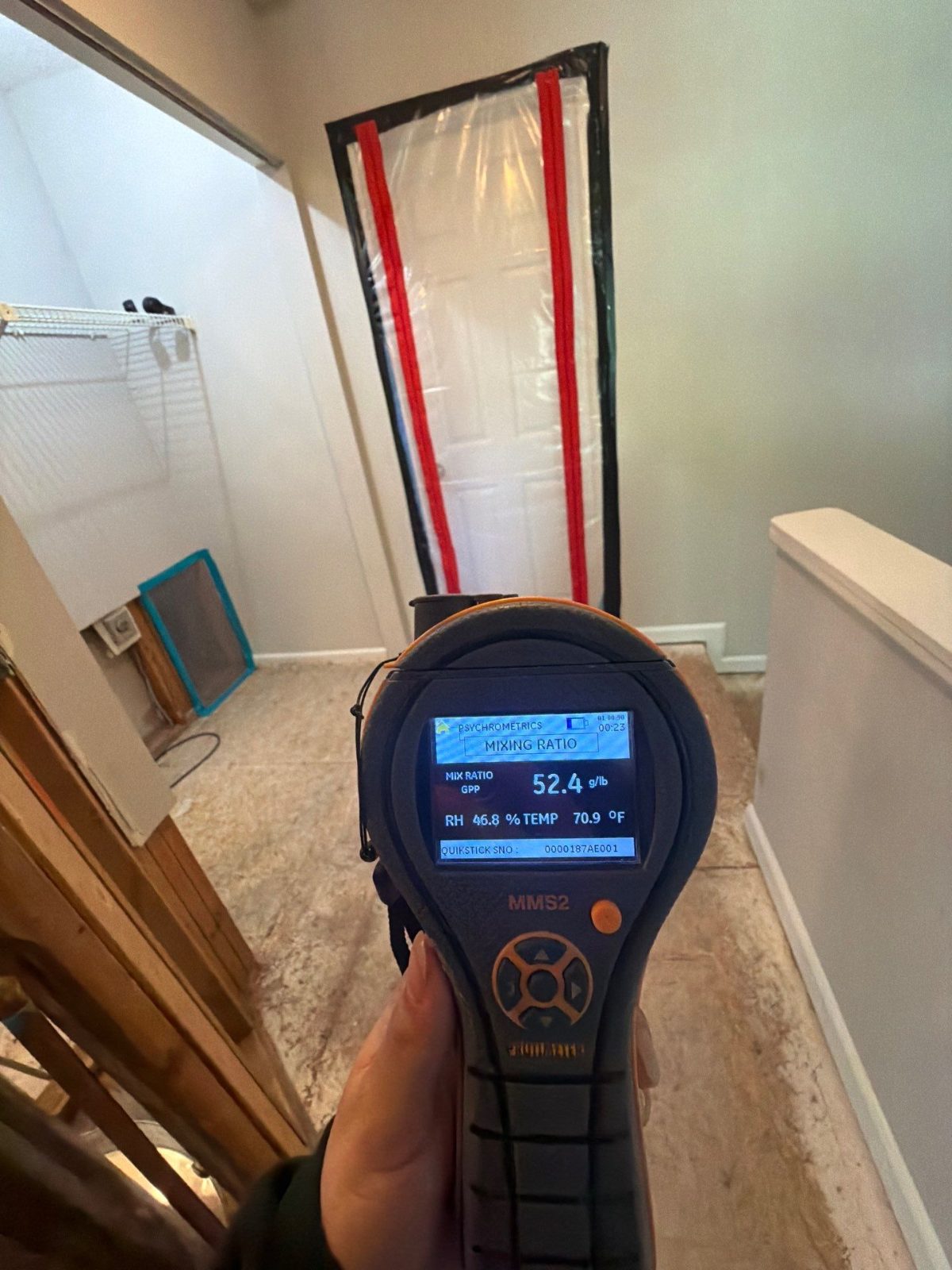
- Get a professional assessment. Moisture mapping, a thermal scan and a written scope show the adjuster the mold is contained to the area the covered water reached. Our mold inspection is free and produces exactly that document.
- Follow a recognized remediation process. Containment, HEPA filtration, removal of affected porous materials, cleaning of the rest, and a clearance check. The EPA’s Brief Guide to Mold, Moisture and Your Home describes the principles, and our step-by-step article on the mold remediation process walks through how it looks on a real job.
- Keep the clearance report. It proves the work was complete, which protects you at resale and if the insurer questions the invoice.
What insurers look for when they deny mold claims
Adjusters and the engineers they hire look for signs that the moisture was long-term: layered staining, rusted fasteners, rotted framing, efflorescence on block walls, multiple generations of mold growth, or caulk that failed years ago. If the evidence shows a slow process, the claim is usually denied regardless of how the homeowner describes it. If it shows a single wetting event with fresh, uniform growth, the claim usually proceeds.
When you believe a denial is wrong, ask for the engineer’s report, submit your own contractor’s findings, and if needed file a complaint with the Georgia Office of Insurance and Safety Fire Commissioner. Keep the conversation factual: dates, moisture readings and photos win more disputes than frustration does.
Preventing the mold that insurance will never pay for
Does homeowners insurance cover mold from humidity? No, so prevention is the only coverage you have against it. The EPA recommends keeping indoor humidity below 60 percent, ideally between 30 and 50, and drying anything wet within 24 to 48 hours. In metro Atlanta that usually means running the air conditioner enough to dehumidify, adding a dehumidifier in basements, venting bathrooms and dryers outdoors, and sealing or conditioning crawl spaces. Our mold prevention tips go into detail for this climate.
When mold does appear, we remove it with containment, HEPA air scrubbing and botanical antimicrobials. You can read the product details on the Bioesque botanical disinfectant page. We also offer a clearance check after the work so you have a clean report in hand.
Need help now? ATL Restoration answers 24/7 at (770) 744-1282. Inspections are free for homes and businesses across metro Atlanta. Learn more about our mold removal services or see every city we serve.
Frequently asked questions
Does homeowners insurance cover black mold?
The color of the mold does not change coverage. What matters is why it grew. Mold of any species that resulted from a sudden, covered water event is usually covered up to the policy’s mold limit. Mold from humidity, condensation or a long-term leak is usually excluded.
How much mold coverage does a typical policy include?
Many standard policies cap mold-related costs at a sub-limit that is far lower than the overall dwelling limit, and the cap often applies to testing, removal and the repairs needed to reach the mold. Some carriers offer a higher limit as an endorsement. Check your declarations page for a line that mentions fungi, mold or microbial.
Will my insurer pay for a mold inspection?
If the mold is tied to a covered claim, assessment and clearance testing are often included within the mold sub-limit. If there is no covered event behind it, the inspection is usually your cost. ATL Restoration offers free inspections, which is a good place to start before anyone files anything.
Does renters insurance cover mold?
Renters policies follow the same logic as homeowners policies: mold damage to your belongings from a sudden covered event may be covered, usually with a limit, while mold from the building’s condition is the landlord’s problem to fix. Report the moisture to your landlord in writing as soon as you notice it.
Can an insurer drop me for a mold claim?
Carriers in Georgia can choose not to renew a policy at renewal time, and a history of water or mold claims can affect that decision or your rate. One well-documented claim rarely causes it. Repeated claims for the same unresolved leak are a different story, which is another reason to fix the moisture source properly the first time.
What if the mold is behind a wall and I only smell it?
A musty smell with no visible mold is one of the signs the EPA lists for hidden mold. Do not open the wall yourself, because disturbing it can release spores. Have a professional inspect with moisture meters and a thermal camera, document what they find, and then decide with your agent whether the cause is a covered event.